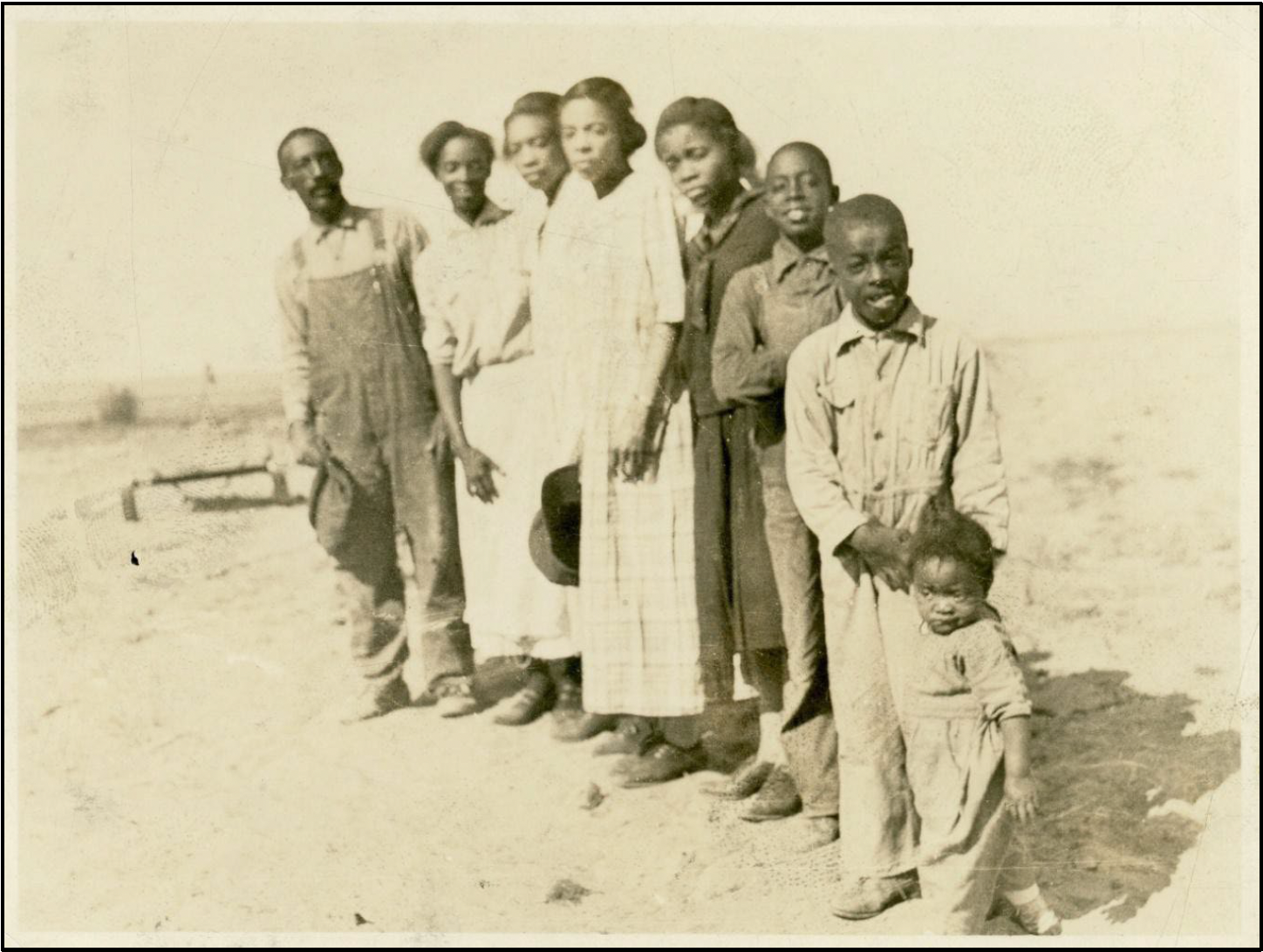
A Bold Vision of Freedom and Self-Sufficiency
On May 5, 1910, the Denver Star reported that Oliver Toussaint "O.T." Jackson and others had staked a settlement on 20,000 acres of government land in Weld County, Colorado. It was a moment that would reshape the story of African American life in the American West.
Jackson — an entrepreneur active in Denver and Boulder — founded the settlement on the ideals of Booker T. Washington, who championed African American economic self-sufficiency, land ownership, and social advancement. Jackson identified government land in Weld County with the explicit goal of establishing an African American agricultural colony where Black families could claim their rightful place in the American dream.
The colony was named Dearfield — a portmanteau meant to evoke the dear fields of opportunity that awaited its settlers. Jackson platted the town site under the Enlarged Homestead Act of 1909, building a small commercial hub with businesses to support a wider circle of independent farming families. Crawford Hicks was among the earliest to respond, filing on 160 acres on September 3, 1910.
Growth and Prosperity (1910–1917)
The early years of the colony benefited from unusually heavy rainfall, producing good crop yields that attracted new settlers eager to share in the success. Advertisements from the era promoted Dearfield's "prosperous farming opportunities" on non-irrigated land — an optimistic claim that would later prove complicated as the climate reverted to its typical aridity.
By 1917 — the year Crawford Hicks received full title to his 160 acres — the Denver Star reported that over 60 African American families had homesteaded more than 15,000 acres of the 30,000 identified for the Colony. The paper published a directory of every family who had purchased lots in the townsite and settled farmland in the surrounding settlement. It was the Colony's zenith.
The Hicks homestead was among the most prominent. With six rooms — one of the largest houses in the entire settlement — it served as the social center of Dearfield Colony life. O.T. Jackson himself designated the Hicks home as the place to entertain important guests. Among them: Booker T. Washington Jr., son of the renowned civil rights leader, who stayed at the Crawford house during a tour of Colorado.
"Anytime anybody came to town . . . we had a six-room house. That was the biggest house out there, and mama had nice things she brought from town. We were the only ones he [O.T. Jackson] figured could entertain anybody."
— Carrie Lillian Hicks Wood, Interview, Denver, August 18, 1994
The Colony and the Larger African American Community
Dearfield was never isolated from the broader African American community. Many colonists split their time between the settlement and Denver, 70 miles to the south. The 1920 census captures this dynamic: Crawford and Ethel Hicks were enumerated first at their Denver rental property on East 26th Avenue, and then again in Weld County — described as independent farmers who owned their home.
Ethel Hicks was a key connector between Dearfield and Denver's vibrant Black civic life. The Denver Star announced that the Taka Art and Literary Club — an African American women's organization committed to self-improvement and community philanthropy — would hold a 1918 meeting at the home of Mrs. Ethel Hicks at Dearfield. This club was part of the Denver Federation of Colored Women, an umbrella organization for 22 women's clubs across the city. Ethel's hosting of this meeting illustrates the deep social and cultural networks that connected the homestead to Denver's African American leadership class.
Crawford and Hattie Rothwell were prominently featured in promotional materials for the Dearfield settlement, and both had streets named after them in the town site — a mark of distinction that speaks to their standing in the community.
Decline and the End of an Era (1920s–1930s)
A confluence of forces converged to undermine Dearfield's success by the mid-1920s. The unusually wet years gave way to drought. Federal land policy had stacked the deck against small family owner-operators, with requirements often incongruent with the reality of the arid, high-elevation West. The national farm economy faltered in a post-World War I slump that deepened into the Great Depression.
The 1920s also saw significant Ku Klux Klan growth and activity in Colorado — including in Denver, to which many Dearfield families permanently relocated. While no direct evidence of KKK attacks on Dearfield residents has been documented, the climate of racial hostility was undeniably part of the era.
By the 1930 census, Dearfield had become a "virtual ghost town," having lost more than 70% of its African American inhabitants, with only 10 households and 25 residents remaining. The Hicks family was among the very few who did not simply abandon their land.
The Hicks: A Rare Success Story
What set the Hicks family apart was water. Their property was naturally blessed — featuring two lakes and situated near a reliable water source — while neighboring farms withered in the drought.
"We stayed longer. We had a better setup than anybody because of the water. We had a lot of little things that brought in money that some people didn't have."
— Carrie Lillian Hicks Wood, Interview, Denver, August 18, 1994
The Hicks homestead remained in the family long after most Dearfield families had departed. The last full-time resident, Walter Wood (husband of Carrie Hicks), worked the property until his death in 1973 — 63 years after the family first settled the land. Today, the Hicks descendants are among the only remaining African American landowners in the area with direct ties to the Dearfield Colony.
African American Homesteading in Context
Dearfield was one of only two African American agricultural colonies in Colorado. The other — known as The Dry (5OT121) — was located in Otero County in southeastern Colorado, near Manzanola. Like Dearfield, The Dry experienced a similar arc of growth and retraction, and unlike the Hicks Homestead, no buildings from its settlement period survive today.
Nationally, African American homesteading settlements included Nicodemus, Kansas (established 1877, now a National Park Service site) and New Philadelphia, Illinois (established mid-1800s, the oldest known African American settlement in the United States). The Homestead National Historical Park describes Black homesteaders as participants in "a deeply American story — a story of migration, risk taking, immense toil, hardship, sacrifice, courage in the face of long odds, disappointment, joy, and for many, triumph."
The Hicks Homestead stands in this proud tradition — and, unlike so many of its peers, it still stands at all.